Far Eastern Design
By Rochelle Caviness
When talking about Far Eastern Design, many people, especially westerns, fail to realize that there is not just one 'type' of Far Eastern design. Each region, culture, and ethnic group maintains it own distinct style. Even when looking at a single country you cannot say that it has an uniformed design style.
China
Take for example, China. China has a population of about 1.3 billion people, which consists of 56 officially recognized ethnic groups. The largest of these ethnic groups is the Han people, who comprise about 91% of the Chinese population.
- The premier Chinese design style, which is currently gaining much favor in the West, is the Chinese art of Feng Shui. This style is based upon Taoist philosophy and the practice of divination associated with the I Ching.
Feng Shui
Harmony is the underlying tenet of Feng Shui. It involves the art of placing objects in such a manner that they harmonize with all other elements within a given environment. The decision on where to place items is, in part, based upon the Chi (Qi) of an item. Chi refers to the natural energy that flows through an object. If items are arranged properly, it is believed that you will be more productive, comfortable, and successful when working or living in such a harmonious environment.
- Feng Shui designs always incorporate five basic elements: Fire, wood, earth, water, and metal.
- These elements do not have to be present in their natural form. For example, you do not need to have an open flame to incorporate fire into your design. You merely need to have an aspect of fire present, such as by using some red cloth in your overall design.
- In Feng Shui designs, major elements such as a bed, desk, or workstation are always positioned so that you have a clear view of the main doorway into the room.
- Mirrors should be positioned so that they expand desirable elements. For example, a mirror can be placed facing a table so that it appears that you have more food. (This is a favorite tactic of buffet style restaurants.)
- Avoided pointed objects. For instance, a rounded table is more in line with Feng Shui than is a square one.
Japan
In addition to China, Japan has had a great deal of influence upon western design philosophy. The main style that has been exported from Japan is based upon the Zen Buddhist and Shinto philosophy of minimalism.
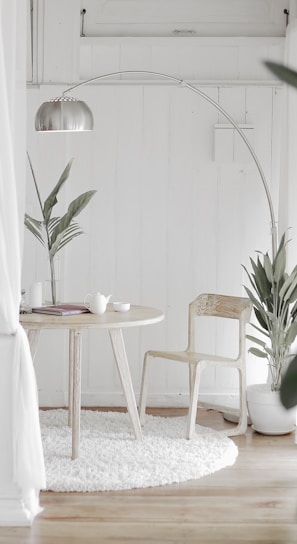
- This means that rooms are free of clutter. Items are stored away out of sight. It is as if their homes are a stage, onto which props are brought into view only when needed.
- Traditional Japanese homes use neutral, natural colors and tend to shy away from painting materials, preferring to leave items in their natural state.
- Furnishings and rooms are arranged geometrically.
- Artwork is uncomplicated and strongly graphically.
- Japanese decor makes use of a wide range to textures, ranging from silk to pebbles.
- Contrasting images are favored, as long as they are harmonious and in balance with each other.
- Furnishings are minimal and always functional.
Giving Your Home an Eastern Flare
It is virtually impossible to totally transform your home to conform to a true Japanese Zen style or to a Feng Shui style unless you also transform your mental attitude toward these paths.
- However, this does not mean that you cannot make use of specific elements, or Far Eastern strategies, in your own home. By studying Eastern philosophy, you can gain an appreciation of the theory and from there strive to incorporate specific elements into your own decor.
Decorating with Far Eastern Elements
When decorating your home, the layout and furnishings you use will have a major impact upon the look and feel of a room. You can enhance the feel of a room by decorating with Far Eastern elements, such as:
- Kimonos can be hung on the wall, serving as both a work of art and an accent piece.
- Japanese or Chinese knotted pillows, or other culturally identifiable craft items can be used with western furnishing.
- Cover your floor with Tatami mats or Japanese floor pillows.
- Use reprints of Japanese or Chinese art works, such as Chinese watercolors or Japanese block prints to decorate your walls.
- Statues of deities or lucky spirits, such as Japanese Foo dog statues that will guard your home, while adding and eastern flare to your home.
The information provided on this site is for informational purposes only.
Always consult your doctor for medical advice.
|
Copyright © Tundraco & Tundraco.com 2003 - 2007 - All Rights Reserved